-
Shop
- Adidas
- Advanced Technologies
- AI Skills Mastery 2026 Collection
- Astrology & Tarot Products
- Beauty
- Beauty Guides Collection
- Best-Sellers
- Car Accessories
- Confidence
- Dating & Social Skills
- Digital Resources
- AI & Technology
- AI Skills
- Budgeting & Saving
- Car Buying & Ownership
- Cozy Feast Collection
- Electronics & Technology
- Emotional Intelligence
- Entrepreneurship & Business Growth
- Financial Education
- Financial Independence
- Financial Mindset & Psychology
- Goal Setting
- Hobbies
- Home Styling & Organization
- Kitchen & Recipes
- Leadership
- Mindfulness
- Mindset
- Motivation
- Online Business
- Parenting & Child Development
- Pet Lifestyle & Wellness
- Positive Thinking
- Productivity
- Self Confidence
- Sleep Improvement
- Smart Life with AI
- Stress Management & Relaxation
- Travel Planning
- Yoga & Fitness
- Yoga & Mind-Body Practices
- Education & Learning
- Family & Parenting
- Fashion
- Alexander McQueen
- Bags
- Bags & Wallets
- Balenciaga
- Belts
- Blazers
- Bottega Veneta
- Brunello Cucinelli
- Burberry
- Chanel
- Chloé
- Dior
- Dolce & Gabbana
- Dresses
- Etro
- Fendi
- Gucci
- Hats & Hair Accessories
- Hoodies & Sweatshirts
- Jacquemus
- Jil Sander
- Keychains
- Kiton
- Luggage
- Miu Miu
- Off-White
- Outerwear
- Prada
- Rick Owens
- Saint Laurent
- Shoes
- Socks & Tights
- Sweaters & Cardigans
- The Row
- Tom Ford
- Tops & Shirts
- Valentino
- Valentino Garavani
- Versace
- Vivienne Westwood
- Watches
- Fashion Accessories
- Furniture
- Gadgets
- Health & Beauty
- Health & Wellness
- Home & Garden
- Home Supplies
- Jewelry
- Kids & Babies
- Kitchen
- Kitchen Best-Sellers
- Nike
- Patio, Lawn & Garden
- Personal Growth
- Personal Style & Fashion
- Pet Care
- Pet Supplies
- Pets
- Smart Home Living Guides
- Sport & Outdoors
- Stress Relief & Relaxation
- Super Deals
- TikTok Growth & Monetization Mastery
- Travel
- Travel & Adventure
- Wealth
- Wellness
- Popular
- Best deals
Build a 5-Year Plan That Sticks (Without Burnout)

Big goals feel motivating—until daily life crowds them out. A five-year plan works when it’s clear enough to act on today, flexible enough to survive real-life changes, and measurable enough to show progress. Below is a practical system for choosing the right goals, breaking them into milestones, and building routines that keep them moving.
Start with a clear picture of “best self”
A five-year plan isn’t a list of wishes—it’s a picture of how you want your weeks to feel and function. Start by narrowing your focus to the areas that actually shape your day-to-day life.
- Pick 3–5 life areas that matter most right now: health, career, money, relationships, learning, home, creativity.
- Write a “future snapshot” for each area. Describe a normal week (workouts, meals, workload, spending habits, time with family), not just an end result.
- Create identity statements that guide decisions: “A person who trains consistently,” “A person who follows a simple budget,” “A person who studies before scrolling.”
- Choose one theme for the next year that supports the five-year vision—stability, growth, skill-building, recovery, or leadership.
That yearly theme acts like a filter. When new opportunities pop up (or distractions), you can quickly ask: “Does this support the theme?”
Choose goals that fit the season of life
Overloading your plan is the fastest way to dilute effort and burn out. Keep it simple enough to sustain through busy weeks.
- Limit the year to 3 primary goals. Everything else goes into “maintenance mode” or “later.”
- Run each goal through three checks: meaning (why it matters), feasibility (time/energy), and controllability (actions you can take).
- Replace ambient goals with behaviors. “Be healthier” becomes “strength train 3x/week” or “cook at home on weekdays.”
- Decide what gets deprioritized. A realistic plan includes what you’ll pause, stop, or keep minimal.
Quick goal fit check
| Goal idea | Why it matters | Weekly actions | What gets paused |
|---|---|---|---|
| Run a half marathon | Energy, confidence, stress relief | 3 runs + 1 strength session | Extra projects on weeknights |
| Build an emergency fund | Reduced anxiety, more choices | Auto-transfer each payday | Nonessential subscriptions |
| Earn a new certification | Career mobility, skills | 3 focused study blocks/week | Scrolling time after dinner |
If you can’t name the weekly actions, it’s not a goal yet—it’s a hope.
Turn five-year goals into milestones you can hit
From five years to this week (example structure)
| Timeframe | Milestone | Leading indicator (action) | Tracking method |
|---|---|---|---|
| 5 years | Desired outcome clearly stated | Core habits sustained | Annual review notes |
| 1 year | Key milestone that moves the needle | Weekly practice blocks scheduled | Weekly checklist |
| 90 days | One measurable step forward | 2–5 actions repeated consistently | Habit tracker / calendar |
| This week | Small win that keeps momentum | Show up for the next session | Daily check-in |
Build goals into routines so they don’t rely on motivation
Follow-through improves dramatically when actions are scheduled, cued, and easy to start. Research on implementation intentions shows that specifying when and where you’ll act increases the odds you actually do it (Gollwitzer).
Well-defined goals can improve task performance, especially when they’re specific and paired with feedback loops (Locke & Latham). The key is turning “feedback” into a simple routine you’ll keep.
Track progress in a way that keeps you honest and encouraged
Simple review questions
| Cadence | Questions to ask | Output |
|---|---|---|
| Weekly (10–15 min) | What were the top 3 actions? What blocked them? What’s one change for next week? | Next week’s schedule + one adjustment |
| Monthly (30 min) | What’s improving? What’s stalled? What needs a new approach? | Updated milestone and habit targets |
| Quarterly (60 min) | Are these still the right goals? What should be added/removed? | Next 90-day focus |
Stay consistent when life changes
Small wins are not “less than.” They’re how momentum stays intact long enough for big change to compound—an idea popularized in modern habit frameworks (see James Clear).
A guided option for planning your next five years
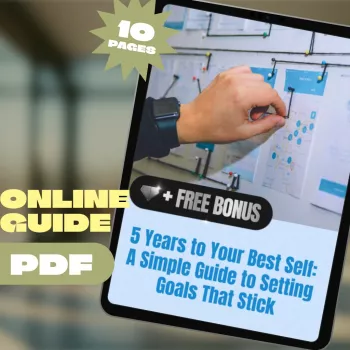
- 5 Years to Your Best Self: A Simple Guide to Setting Goals That Stick (digital eBook)
- Budget Style Strategy Bundle for Everyday Looks – 5-in-1 Digital Download (useful if your five-year plan includes simplifying your wardrobe and spending)
- 70″ Suede Leather Sofa with Tufted Design (helpful for “home” goals like upgrading a living space you actually use)
What to look for in a digital goal-setting guide
| Feature | Why it helps | How to use it |
|---|---|---|
| Vision prompts | Clarifies priorities and reduces goal clutter | Write short future snapshots per life area |
| Milestone mapping | Turns long-term goals into doable steps | Backcast into yearly and 90-day targets |
| Weekly planning pages | Protects time for the actions that matter | Schedule 2–5 repeatable actions |
| Review templates | Creates a feedback loop for adjustment | Weekly and monthly check-ins |
FAQ
How many goals should be in a five-year plan?
Focus on a few major outcomes across 3–5 life areas, then choose just 1–3 primary goals for the current year. Fewer goals improves follow-through because your time, energy, and attention aren’t spread thin.
What’s the difference between a five-year goal and a one-year goal?
A five-year goal sets direction and defines the bigger outcome you’re working toward, while a one-year goal is the next meaningful milestone that proves you’re on track. Backcasting helps you connect the two, and using leading (actions) and lagging (results) indicators keeps progress measurable.
What should happen if progress stalls for a month?
Run a quick reset: identify what blocked you, reduce the scope to a minimum viable version, adjust your environment to make starting easier, and schedule the next week immediately. The priority is restarting fast rather than “making up” for lost time.















Leave a comment