-
Shop
- Adidas
- Advanced Technologies
- AI Skills Mastery 2026 Collection
- Astrology & Tarot Products
- Beauty
- Beauty Guides Collection
- Best-Sellers
- Car Accessories
- Confidence
- Dating & Social Skills
- Digital Resources
- AI & Technology
- AI Skills
- Budgeting & Saving
- Car Buying & Ownership
- Cozy Feast Collection
- Electronics & Technology
- Emotional Intelligence
- Entrepreneurship & Business Growth
- Financial Education
- Financial Independence
- Financial Mindset & Psychology
- Goal Setting
- Hobbies
- Home Styling & Organization
- Kitchen & Recipes
- Leadership
- Mindfulness
- Mindset
- Motivation
- Online Business
- Parenting & Child Development
- Pet Lifestyle & Wellness
- Positive Thinking
- Productivity
- Self Confidence
- Sleep Improvement
- Smart Life with AI
- Stress Management & Relaxation
- Travel Planning
- Yoga & Fitness
- Yoga & Mind-Body Practices
- Education & Learning
- Family & Parenting
- Fashion
- Alexander McQueen
- Bags
- Bags & Wallets
- Balenciaga
- Belts
- Blazers
- Bottega Veneta
- Brunello Cucinelli
- Burberry
- Chanel
- Chloé
- Dior
- Dolce & Gabbana
- Dresses
- Etro
- Fendi
- Gucci
- Hats & Hair Accessories
- Hoodies & Sweatshirts
- Jacquemus
- Jil Sander
- Keychains
- Kiton
- Luggage
- Miu Miu
- Off-White
- Outerwear
- Prada
- Rick Owens
- Saint Laurent
- Shoes
- Socks & Tights
- Sweaters & Cardigans
- The Row
- Tom Ford
- Tops & Shirts
- Valentino
- Valentino Garavani
- Versace
- Vivienne Westwood
- Watches
- Fashion Accessories
- Furniture
- Gadgets
- Health & Beauty
- Health & Wellness
- Home & Garden
- Home Supplies
- Jewelry
- Kids & Babies
- Kitchen
- Kitchen Best-Sellers
- Nike
- Patio, Lawn & Garden
- Personal Growth
- Personal Style & Fashion
- Pet Care
- Pet Supplies
- Pets
- Smart Home Living Guides
- Sport & Outdoors
- Stress Relief & Relaxation
- Super Deals
- TikTok Growth & Monetization Mastery
- Travel
- Travel & Adventure
- Wealth
- Wellness
- Popular
- Best deals
Enneagram 6 Motivation Checklist for Steady Follow-Through

Checklist: Motivating the Loyal Enneagram 6 — A Steady Path to Success
Enneagram 6s thrive when motivation feels safe, clear, and supported. When uncertainty spikes, a Type 6 can get pulled into overthinking, second-guessing, or seeking “one more” reassurance—especially right before action. A practical checklist helps turn that anxious energy into grounded follow-through: name the risk, make a simple plan, and take the next small step.
This printable-friendly approach is built for real life: personal goals, work projects, study plans, and coaching conversations—without forcing a “just be positive” mindset. For a deeper overview of Type 6 patterns, see The Enneagram Institute — Type Six (The Loyalist).
What makes Enneagram 6 motivation unique
- Security-first drive: momentum builds when risks are named and addressed, not ignored.
- Loyalty and responsibility: commitment strengthens when purpose and expectations are explicit.
- Scanning for what could go wrong: planning is a strength when it’s time-boxed and paired with action.
- Inner authority grows with practice: small, repeatable decisions reduce second-guessing over time.
Type 6 motivation often isn’t about “trying harder.” It’s about creating enough clarity and structure that action feels sensible. When stress is high, it can help to remember that stress responses are normal and trainable; resources like American Psychological Association — Stress and National Institute of Mental Health — Coping with Stress offer useful grounding tools to pair with planning.
Quick start: the 10-minute reset for a stressed 6
- Name the real fear in one sentence (what consequence are you trying to avoid?).
- Sort concerns into “can control,” “can influence,” and “can’t control.”
- Pick one stabilizing action (send the email, book the appointment, outline the next step).
- Set a short timer (10–20 minutes) to start before more research or reassurance-seeking.
- Close with one evidence check: “What evidence says this is workable?”
This reset works because it honors fear without letting fear become the project. The goal isn’t to eliminate doubt; it’s to keep doubt from hijacking your next action.
The Loyal 6 motivation checklist (printable-friendly)
- Clarity: define the goal in one sentence and identify what “done” looks like.
- Safety: list top 3 risks and one mitigation for each (plan, backup, boundary).
- Support: decide who to consult vs. who to inform (avoid asking everyone).
- Constraints: set a deadline and a “good enough” standard to prevent perfection loops.
- Action: choose the next physical step that can be done in 15 minutes or less.
- Reassurance plan: limit checking to a scheduled window (e.g., one review at 3 PM).
- Confidence rep: write one past example of handling something similar.
- Accountability: pick one follow-up time and one person (or a self-check reminder).
- Recovery: include one regulation tool (walk, breathing, tidy workspace, music) before major tasks.
- Finish: acknowledge completion and capture one lesson to reduce future doubt.
Common Type 6 blocks and the matching motivation lever
| When it feels like… | What’s usually happening | Try this instead |
|---|---|---|
| “I need more information.” | Anxiety disguising itself as research. | Time-box research (15–30 minutes), then take one small action. |
| “What if this goes wrong?” | Threat scanning without a plan. | Write a simple Plan A/Plan B and move forward with Plan A. |
| “I’m not ready yet.” | Waiting for certainty. | Define the minimum viable start and do it imperfectly. |
| “I should ask someone.” | Externalizing authority. | Ask one targeted question to one person; decide the rest internally. |
| “I can’t relax until it’s finished.” | Over-responsibility. | Set a stopping rule and a next review date; then disengage on purpose. |
How to use the checklist for work, study, and daily life
- Work projects: use it at kickoff to clarify scope, risks, and decision owners—so you aren’t carrying unspoken expectations.
- School or skill-building: pair it with a weekly plan (one priority goal, two support actions, one review) to avoid last-minute spirals.
- Relationships: apply it before hard conversations—define the desired outcome, boundaries, and a calm-down plan for after.
- Health habits: create a “default routine” and a “backup routine” so one missed day doesn’t become a full stop.
- Major changes: break decisions into stages (explore → decide → commit → review) to reduce overwhelm and build trust in your process.
Supportive self-talk that works for a 6 (without bypassing fear)
- Replace “I need certainty” with “I need a plan and a next step.”
- Replace “Something will go wrong” with “If something goes wrong, there’s a response I can take.”
- Replace “I can’t decide” with “I can decide for now and revisit at a scheduled time.”
- Replace “I’m behind” with “What’s the smallest stabilizing action I can do today?”
- Use a closing script after action: “I showed up. I can adjust later.”
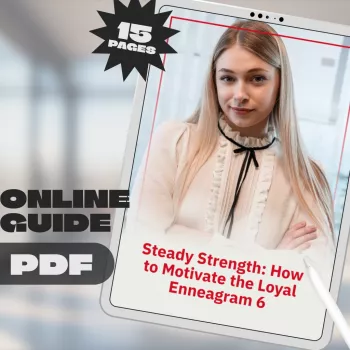
Printable PDF guide: what’s included and who it’s for
Get the checklist: digital download
FAQ
How can an Enneagram 6 stay motivated without constant reassurance?
Create a reassurance plan: one scheduled check-in, one trusted person, and time-boxed research. Add a written Plan A/Plan B so you can act with support while strengthening your internal authority.
What’s the best way for a Type 6 to make decisions faster?
Use staged decisions (explore → decide → commit → review) and set a “good enough” threshold. Then choose one next action you can do within 15 minutes to create momentum.
Is this checklist useful if someone isn’t sure they’re a Type 6?
Yes—it’s helpful for anyone who overthinks, seeks safety, or worries about worst-case scenarios. Try it for a week and notice whether clarity, follow-through, and stress levels improve.
Recommended for you


Nordic Black & White Ceramic Onion Spice Jar Set
Jul 24, 2026













Leave a comment