-
Shop
- Adidas
- Advanced Technologies
- AI Skills Mastery 2026 Collection
- Astrology & Tarot Products
- Beauty
- Beauty Guides Collection
- Best-Sellers
- Car Accessories
- Confidence
- Dating & Social Skills
- Digital Resources
- AI & Technology
- AI Skills
- Budgeting & Saving
- Car Buying & Ownership
- Cozy Feast Collection
- Electronics & Technology
- Emotional Intelligence
- Entrepreneurship & Business Growth
- Financial Education
- Financial Independence
- Financial Mindset & Psychology
- Goal Setting
- Hobbies
- Home Styling & Organization
- Kitchen & Recipes
- Leadership
- Mindfulness
- Mindset
- Motivation
- Online Business
- Parenting & Child Development
- Pet Lifestyle & Wellness
- Positive Thinking
- Productivity
- Self Confidence
- Sleep Improvement
- Smart Life with AI
- Stress Management & Relaxation
- Travel Planning
- Yoga & Fitness
- Yoga & Mind-Body Practices
- Education & Learning
- Family & Parenting
- Fashion
- Alexander McQueen
- Bags
- Bags & Wallets
- Balenciaga
- Belts
- Blazers
- Bottega Veneta
- Brunello Cucinelli
- Burberry
- Chanel
- Chloé
- Dior
- Dolce & Gabbana
- Dresses
- Etro
- Fendi
- Gucci
- Hats & Hair Accessories
- Hoodies & Sweatshirts
- Jacquemus
- Jil Sander
- Keychains
- Kiton
- Luggage
- Miu Miu
- Off-White
- Outerwear
- Prada
- Rick Owens
- Saint Laurent
- Shoes
- Socks & Tights
- Sweaters & Cardigans
- The Row
- Tom Ford
- Tops & Shirts
- Valentino
- Valentino Garavani
- Versace
- Vivienne Westwood
- Watches
- Fashion Accessories
- Furniture
- Gadgets
- Health & Beauty
- Health & Wellness
- Home & Garden
- Home Supplies
- Jewelry
- Kids & Babies
- Kitchen
- Kitchen Best-Sellers
- Nike
- Patio, Lawn & Garden
- Personal Growth
- Personal Style & Fashion
- Pet Care
- Pet Supplies
- Pets
- Smart Home Living Guides
- Sport & Outdoors
- Stress Relief & Relaxation
- Super Deals
- TikTok Growth & Monetization Mastery
- Travel
- Travel & Adventure
- Wealth
- Wellness
- Popular
- Best deals
Color Season Analysis Made Easy: Find Your True Colors
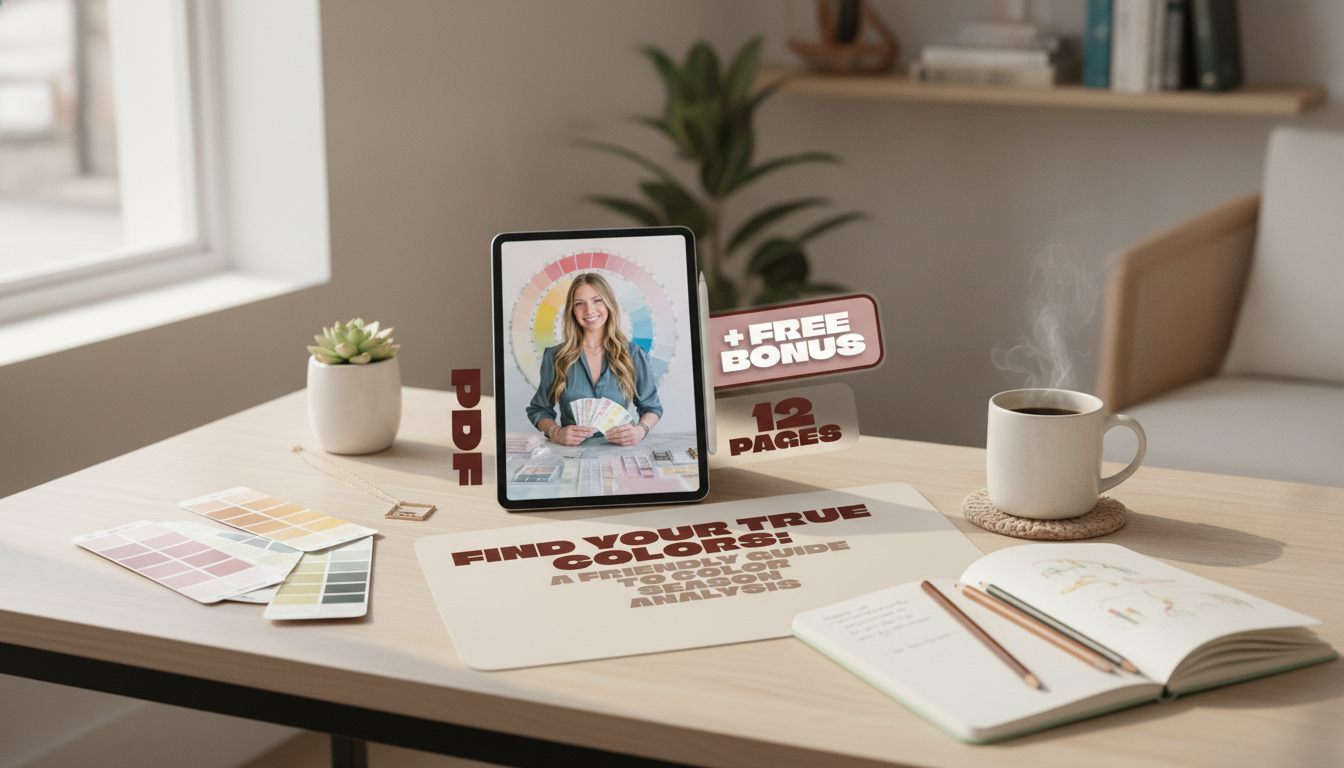
Color season analysis is a simple way to make getting dressed feel easier: when your clothing colors echo your natural undertones and contrast, outfits tend to look more “pulled together” with less effort. Instead of guessing why a top feels a little off (even when it fits), you start choosing shades that naturally flatter your skin, eyes, and hair. For more guidance, see [PDF] Magic of Colors.
This friendly guide breaks down the season approach in clear, beginner-level steps—and shows how the Find Your True Colors: A Friendly Guide to Color Season Analysis eBook can turn a vague “what looks good?” feeling into a repeatable palette you can use while shopping. For further reading, see Colour Analysis Part I: Finding your Type – Anuschka Rees.
What color season analysis is (and what it isn’t)
Color season analysis is a method for identifying a group of colors that harmonize with your natural coloring—mainly your skin undertone, your overall depth (light to deep), and how much contrast you have between your features. It’s often organized into four main season families (Spring, Summer, Autumn, Winter), with common variations like Light, Deep, Soft, and Bright.
It isn’t a rulebook. It’s a shortcut—especially for items worn near the face (tops, scarves, jackets, lipstick) where color has the biggest impact on how even, bright, and balanced your complexion appears. Many people also find it reduces closet clutter, because purchases start to mix and match more easily when they share a consistent “color logic.”
The building blocks: undertone, depth, and contrast
Most confusion around seasons comes from mixing up the building blocks. Keeping them separate makes the process much easier:
- Undertone: warm, cool, or neutral. This influences which “temperature” of color looks most natural on your skin.
- Depth: how light or deep your overall coloring reads (hair + eyes + skin together).
- Contrast: the difference between your features (for example, dark hair with light skin is higher contrast; similar tones are lower contrast).
- Chroma (clarity): whether clear/bright colors feel balanced, or if softer/muted colors look more harmonious.
Quick cues often used in season analysis
| Feature | Leans Warm | Leans Cool | Often Neutral/Mixed |
|---|---|---|---|
| Undertone | Golden/peach cast; some warm metals feel seamless | Pink/blue cast; cool metals feel seamless | Both metal tones look good; undertone hard to read |
| Best whites | Cream/ivory | Crisp white | Both can work depending on contrast |
| Color clarity | Warm clear shades (coral, warm aqua) | Cool clear shades (fuchsia, icy blue) | Softened shades can be most forgiving |
A friendly at-home check: lighting and simple comparisons
You don’t need a perfect setup to start. The goal is consistency—same lighting, same mirror, quick side-by-side comparisons.
- Use indirect daylight near a window when possible; yellow bathroom lighting can distort undertone.
- Compare two versions of the same color: warm vs. cool (coral vs. rosy pink), or warm vs. cool neutral (camel vs. charcoal).
- Watch what happens to your face: clearer eyes, smoother-looking skin, and a more even appearance usually signal harmony.
- Prioritize items near the face—tops, collars, scarves, outerwear—because they influence perceived skin tone the most.
- If warm vs. cool feels inconsistent, your undertone may be neutral; clarity (muted vs. bright) or depth may be doing the heavy lifting.
Season snapshots: how the four families usually behave
Think of the four families as broad neighborhoods, not tiny boxes. Many people sit between them, where “Light,” “Deep,” “Soft,” or “Bright” becomes the deciding factor.
Season family cheat sheet (high-level)
| Season family | Overall feel | Usually works well | Usually harder |
|---|---|---|---|
| Spring | Warm, clear, light-to-medium | Coral, warm turquoise, peach, clear warm greens | Dusty grayish pastels; very dark muted shades |
| Summer | Cool, soft, light-to-medium | Dusty rose, lavender, soft navy, cool taupe | Harsh neon brights; very warm oranges |
| Autumn | Warm, muted, medium-to-deep | Olive, rust, teal, chocolate, warm burgundy | Icy pastels; stark black-and-white contrast |
| Winter | Cool, clear, deep/high contrast | True red, cobalt, emerald, black, crisp white | Beige-heavy looks; overly muted, dusty colors |
How the “Find Your True Colors” eBook helps turn theory into outfits
It’s one thing to recognize “warm” or “cool.” It’s another thing to build outfits you love with confidence. The Find Your True Colors: A Friendly Guide to Color Season Analysis eBook is designed to help you move from abstract labels to practical choices you can repeat.
If you already know (or strongly suspect) a deeper, warmer palette, Deep Autumn Wardrobe Made Easy is a focused option for turning that specific season vibe into everyday outfits. For a broader refresh that pairs well with color guidance, the Budget Style Strategy Bundle for Everyday Looks – 5-in-1 Digital Download can help streamline shopping and outfit planning.
Common hang-ups and easy fixes
A simple palette plan to start using immediately
For a deeper dive into how color is measured and standardized, sources like the International Commission on Illumination (CIE) and the Pantone Color Institute are useful references for understanding why small shifts in hue, value, and chroma can change how a color reads.
FAQ
Can a color season change over time?
Undertone is usually stable, but hair color changes, tanning, graying, and shifting contrast can make a different sub-season feel more flattering. Most of the time, it’s an adjustment of depth or clarity—not starting over from scratch.
What if warm and cool both seem to work?
That often points to a neutral undertone or a stronger influence from muted vs. bright and overall depth. Use daylight comparisons and focus on which colors make your skin look most even and your eyes look clearest.
Do you need a professional analysis to get good results?
Professional draping can speed up the process, but consistent testing with a structured guide can still create a practical palette that’s easy to shop and dress with day to day.
Recommended for you


Best Indoor-Only Pets for Small Spaces & Busy Owners
Jun 17, 2026









Leave a comment